
Introduction
Ensuring seamless and reliable deployments is essential in software development. Pairing Amazon ECS (Elastic Container Service) with Blue/Green Deployment strategies boosts application availability and reduces downtime. This blog discusses how to implement Blue/Green Deployment with ECS, integrated with a CI/CD pipeline using AWS tools such as CodePipeline and CodeDeploy. We will offer practical steps to establish a Blue/Green Deployment pipeline, enabling you to deliver features quickly and efficiently.
Understanding Blue-Green Deployment
Blue/green deployment is a software deployment approach that helps organizations to update their software smoothly and safely. They have two sets of their software running at once: the current version (blue) and the new one (green).The blue environment runs the existing software version, while the green environment runs the new version. Users only see one version live at a time. When the new version is ready, they switch over. If any issues pop up, they can quickly switch back to the old version without causing downtime.
Benefits of Blue-Green Deployment with ECS Fargate
Minimized Downtime:
- Zero-Downtime Deployments: Traffic can be shifted from the Blue environment to the Green environment seamlessly, ensuring that users experience no downtime during the deployment.
Reduced Risk:
-
Quick Rollbacks: If issues are detected with the Green environment, traffic can easily be reverted to the Blue environment, ensuring a quick rollback with minimal impact.
-
Isolated Testing: The Green environment can be tested in isolation before switching traffic, allowing for comprehensive testing without affecting the production environment.
Improved Reliability:
-
Consistent Environments: By deploying in identical environments (Blue and Green), you ensure that the new version is running in an environment that mirrors production exactly.
-
Automated Health Checks: ECS Fargate can automatically perform health checks on the Green environment before traffic is switched, ensuring reliability.
Enhanced Continuous Delivery:
-
Seamless Integrations: Integrates well with CI/CD pipelines, enabling automated testing, deployments, and rollbacks, facilitating a smoother continuous delivery process.
-
Progressive Delivery: Allows for phased traffic switching, such as canary releases, where only a portion of traffic is directed to the Green environment initially.
Cost Efficiency:
-
Optimized Resource Usage: While there are costs associated with running two environments temporarily, ECS Fargate allows you to scale the environments based on demand, optimizing resource usage.
-
Pay-As-You-Go Model: Fargate’s pricing model helps manage costs effectively by charging only for the resources used during the deployment process.
Operational Simplicity:
-
Managed Infrastructure: ECS Fargate handles the infrastructure management, allowing you to focus on application deployment and management rather than underlying infrastructure concerns.
-
Simplified Management: With Fargate, there is no need to provision or manage servers, simplifying the deployment process and reducing operational overhead.
Enhanced Security:
-
Isolation: Each environment (Blue and Green) runs in isolated containers, enhancing security by reducing the risk of cross-environment contamination.
-
Secure Rollouts: Allows for secure deployment and rollback processes, ensuring that any vulnerabilities in the new deployment can be quickly mitigated by reverting to the previous environment.
Scalability:
-
Auto-Scaling: ECS Fargate supports auto-scaling, ensuring that both Blue and Green environments can handle varying loads without manual intervention.
-
Flexible Resource Allocation: Resources can be dynamically allocated based on the requirements of each environment, ensuring efficient scaling and performance.
Understanding CI/CD Integration with ECS Fargate
To integrate CI/CD with ECS Fargate we will be utilizing the AWS codepipeline.Configure all the necessary stages including source code, build and deploy for setting up a CI/CD.
Integrating Blue-Green Deployment with ECS Fargate:Files to be added in source code repo: To integrate blue-green deployment with ECS fargate we need to add 2 files namely taskdef.json and appspec.yaml in the root directory of your source code repository in our case i.e. AWS code commit.
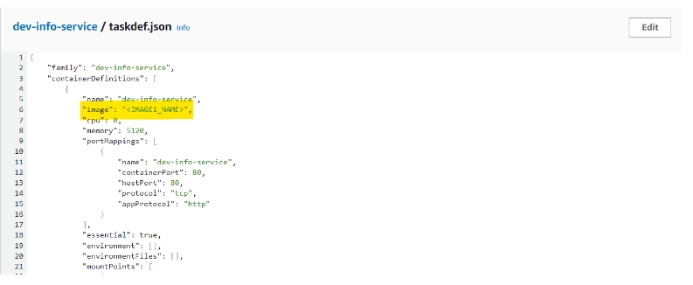
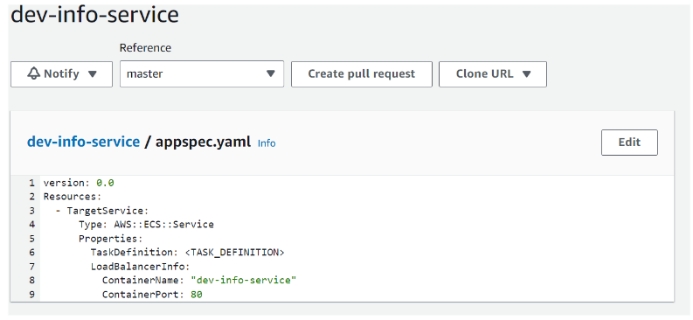
Changes to be done in existing Buildspec.yml: In the exsisting buildspec.yml file add the below line in the post build commands section to generate imageDetail.json as highlighted in below snapshot:
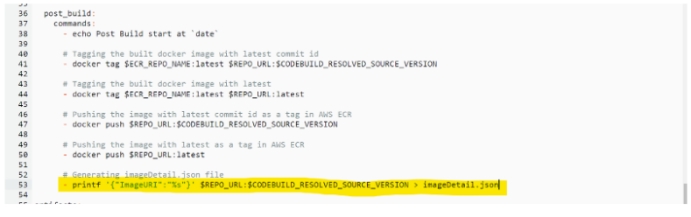
And update the buildspec to save the changes.
Changes to be done in CodePipeline configuration
Now for our codepipeline to utilize the appspec.yml and taskdef.json file during deployment we need to integrate these files to codedeploy for which in the existing pipeline edit the deployment stage:
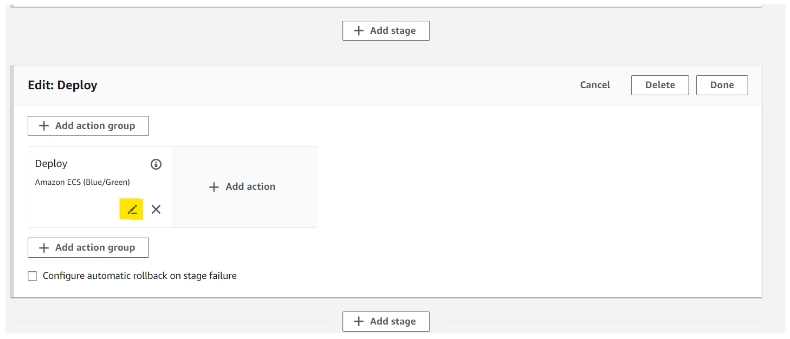
After that in Amazon ECS task definition and AWS CodeDeploy AppSpec file choose BuildArtifact from the dropdown and if you have given any other name to your taskdef.json and appsepc.yaml manually specify the names besides the BuildArtifact section.Also in the Placeholder text in the task definition write as highlighted in below snapshot:
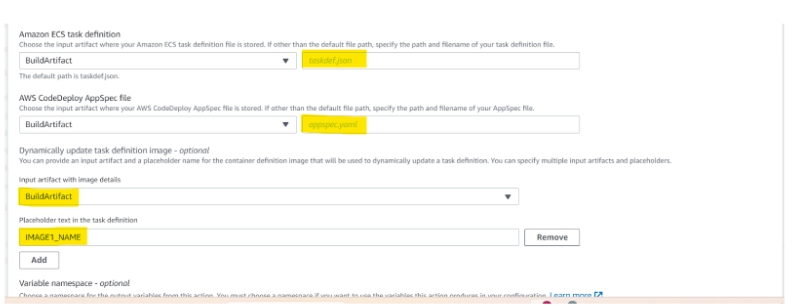
And update the pipeline to save the changes.
Conclusion
In summary, employing Blue-Green Deployment with Amazon ECS Fargate, integrated into a comprehensive CI/CD pipeline, delivers a highly efficient and reliable deployment workflow. This methodology ensures zero-downtime updates, mitigates deployment risks, and boosts scalability, all while simplifying operational processes. Automation of testing, deployments, and rollbacks facilitates continuous delivery, empowering organizations to accelerate innovation and maintain high application availability. This approach not only maximizes resource efficiency but also strengthens security, making it an indispensable solution for contemporary DevOps methodologies.
Written by Prerna Singh