
01 · Client overview
Client overview
About Client
The client is a leading IoT and logistics technology company, providing smart solutions for fleet and supply chain management. The organization specializes in IoT devices, telematics, and real-time data analytics, delivering capabilities that support logistics providers, fleet operators, and enterprise customers. The leading IoT and logistics technology company aimed to migrate its existing infrastructure to AWS Cloud, aligning with industry best practices to improve scalability, reliability, and operational efficiency.
02 · Challenge
Challenge
Before the migration, the existing infrastructure faced frequent challenges with scalability and reliability due to the absence of auto-scaling and multi Availability Zone deployment. The system relied on manual scaling, making it difficult to handle traffic spikes, while a single point of failure posed a significant risk to platform uptime. Without built in elasticity or failover mechanisms, even minor infrastructure issues could lead to service disruptions. Operationally, the environment was complex and inefficient, with no containerization or CI/CD pipelines in place. Deployments were manual, inconsistent, and prone to errors, and there was no proper separation between staging and production environments, increasing the risk of impacting live users. Additionally, the lack of standardized processes made onboarding and troubleshooting slow and challenging.
From a security and observability perspective, the platform lacked centralized identity management, consistent access controls, and audit mechanisms, leading to governance gaps. There was also no monitoring, logging, or cost management framework, resulting in reactive issue detection and unpredictable infrastructure spending. Overall, the absence of visibility, automation, and control limited both operational efficiency and long-term scalability.
03 · Solution
Solution
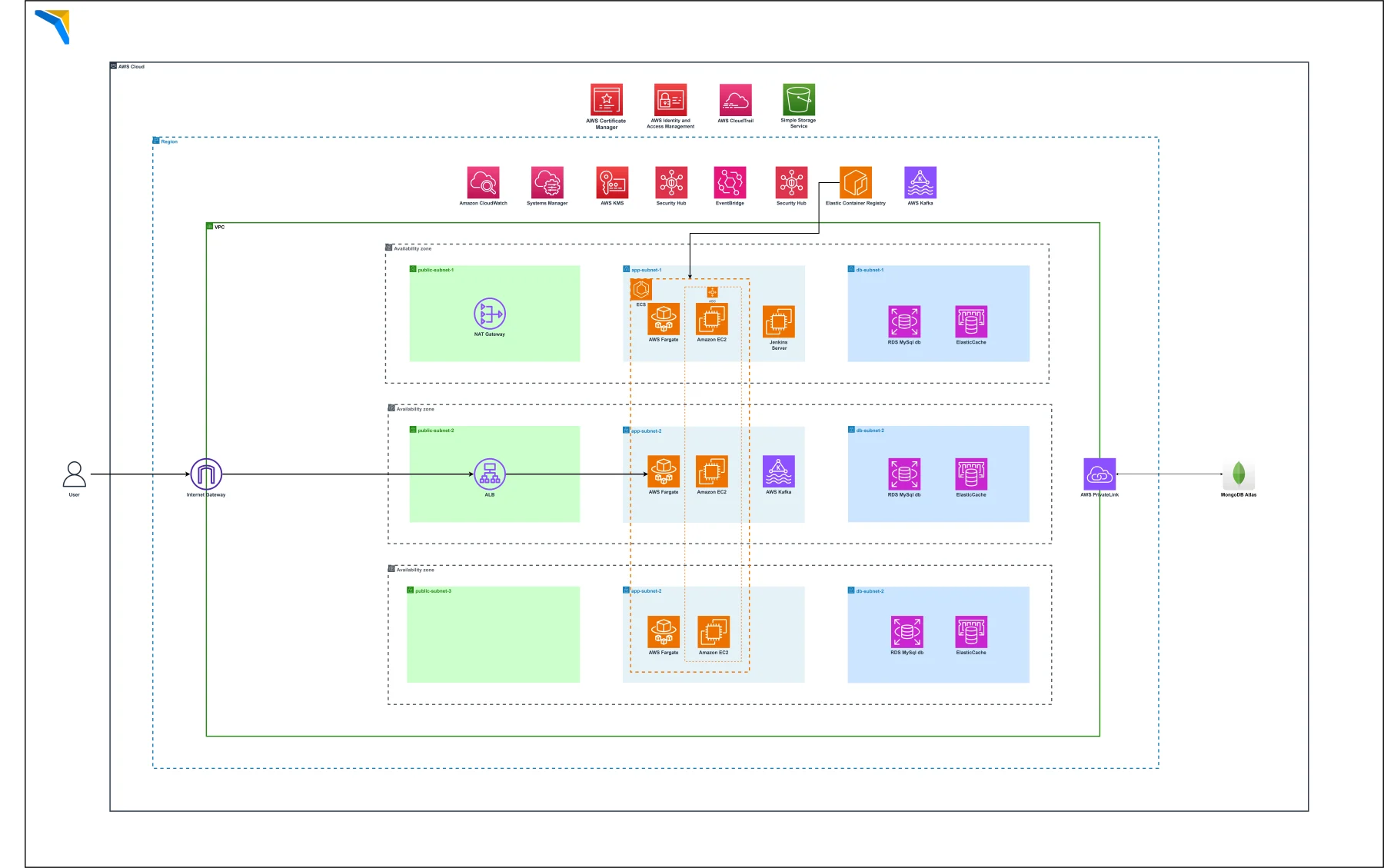
To address these challenges, Comprinno partnered with the rapidly growing IoT-driven logistics platform to design and implement a secure, scalable, and well-governed AWS cloud infrastructure in the Mumbai (ap-south-1) region. The solution established a strong foundation across governance, networking, compute, data, security, and DevOps, ensuring high availability, operational efficiency, and long-term scalability aligned with AWS best practices.
The architecture leveraged AWS-native services to modernize the existing environment, enable containerized workloads, automate deployments, and introduce real-time data streaming capabilities. It also ensured consistent governance, improved observability, and enhanced security posture across all environments.
The application tier runs containerized workloads on ECS using a combination of EC2 (baseline capacity) and Fargate (on-demand scaling), with images stored in ECR and deployed via a Jenkins-driven CI/CD pipeline. AWS MSK (Kafka) enables real-time, multi-AZ event streaming. The data tier leverages RDS PostgreSQL (Multi-AZ, KMS-encrypted) with long-term backups, while Secrets Manager securely manages runtime credentials.
Key Actions:
Cloud Foundation & Governance:
-
Implemented a multi-account strategy using AWS Organizations and Control Tower, covering staging and production environments
-
Established governance guardrails, centralized billing, and secure access using IAM Identity Center (SSO) to ensure compliance and controlled resource usage.
Networking & Architecture Design:
-
Designed a resilient three-tier VPC architecture with isolated staging and production environments.
-
Configured public, application, and database subnets across multiple Availability Zones, along with Internet Gateways, NAT Gateways, and route tables to enable secure connectivity and high availability.
Containerized Compute & Application Deployment:
-
Deployed containerized workloads using Amazon ECS with a hybrid model combining EC2 for baseline capacity and AWS Fargate for dynamic scaling
-
Integrated Application Load Balancer (ALB) for traffic distribution and secured communication using SSL/TLS via AWS Certificate Manager (ACM).
CI/CD Automation:
-
Implemented an automated CI/CD pipeline using Jenkins on EC2 to streamline code integration
-
Docker image build and push to Amazon ECR, and rolling deployments across ECS services, ensuring consistent and reliable releases.
Data Layer: Managed Database & Real-Time Streaming:
-
Deployed PostgreSQL on Amazon RDS with Multi-AZ configuration to ensure high availability, failover support, and data durability, along with encryption using AWS KMS, long-term backups, and point-in-time recovery (PITR).
-
In parallel, implemented real-time event streaming using Amazon MSK (Apache Kafka) across multiple Availability Zones, enabling scalable, reliable ingestion and processing of high-volume telemetry data.
-
Integrated monitoring through Amazon CloudWatch ensures visibility across both database and streaming layers.
Security, Monitoring & Cost Governance:
-
Implemented strong security controls using IAM (least privilege), MFA, AWS KMS encryption, and Secrets Manager, with continuous monitoring via AWS Security Hub.
-
Enabled centralized monitoring and logging using Amazon CloudWatch and AWS CloudTrail for real-time visibility and auditability.
-
Established cost governance using AWS Budgets and Cost Explorer, along with AWS Systems Manager for secure, SSH-free access and operational control.
The architecture is organized with centralized governance using AWS Organizations, Control Tower, and IAM Identity Center to enforce secure, consistent access across all accounts. Public subnets expose only the Application Load Balancer (secured via ACM) and NAT Gateway, while all workloads are isolated within private subnets. Observability and governance are implemented through CloudWatch, CloudTrail, and Security Hub (integrating GuardDuty and Inspector), along with AWS Budgets for cost control, enabling proactive monitoring, enhanced security visibility, and controlled spending.
The application tier is built on containerized workloads orchestrated through Amazon ECS, adopting a hybrid compute model that combines Amazon EC2 for steady, baseline capacity and AWS Fargate for dynamic, on-demand scaling. Container images are securely maintained in Amazon ECR and are continuously delivered via a streamlined CI/CD pipeline powered by Jenkins.
To support real-time data flow, the system integrates Amazon MSK, enabling resilient and highly available event streaming across multiple Availability Zones.
On the data side, the architecture leverages Amazon RDS for PostgreSQL, configured with Multi-AZ deployment to ensure high availability and fault tolerance. Data is protected using encryption via AWS KMS, along with long-term backup retention for durability and recovery. Furthermore, sensitive credentials are securely managed and accessed at runtime through AWS Secrets Manager, enhancing the overall security posture of the system.
04 · Results
Results
Benefits
-
Enhanced Security & Compliance – Strengthened security posture with centralized identity management, least-privilege access, encryption, and continuous threat monitoring, ensuring full auditability and governance.
-
High Scalability & Availability – Achieved elastic scaling with a hybrid ECS model and serverless database, ensuring high availability and elimination of single points of failure across all layers.
-
Improved Operational Efficiency – Automated CI/CD pipelines enabled faster, consistent, and error-free deployments, with clear separation of environments for reliable testing and release management.
-
Optimized Cost Management – Implemented cost-efficient architecture with on-demand scaling and proactive budget monitoring, providing better cost visibility and controlled infrastructure spending.
Conclusion
The partnership resulted in a complete and successful transformation of the cloud infrastructure for the leading IoT and logistics technology company. The new AWS-native platform delivers the scalability, security, observability, and operational maturity required to support current workloads and future growth ambitions. With strong governance enforced through AWS Organizations and Control Tower, elastic compute powered by ECS with a hybrid EC2 and Fargate model, a fully managed and scalable database layer, secure real-time streaming capabilities, and a defence-in-depth security approach using IAM, KMS, Secrets Manager, and Security Hub, the organization is now positioned for reliable, scalable, and well-governed operations. This engagement demonstrates how a well-architected cloud migration strategy, backed by deep AWS expertise, can transform infrastructure challenges into a strategic advantage enabling teams to focus on innovation and business growth rather than infrastructure management.