
01 · Client overview
Client overview
About Client:
Quantian Technologies Pvt Ltd operates in the AI and IT services sector, providing AI-powered workforce management solutions. Its flagship platform, Optick, enables real-time tracking, attendance management, and analytics, delivering tailored solutions for the healthcare, logistics, and education sectors. The platform supports a growing ecosystem of users, requiring a highly scalable, secure, and resilient cloud infrastructure to ensure seamless digital experiences, reliable data processing, and uninterrupted service availability. The platform environment included workloads distributed across multiple cloud providers, including AWS, Azure, and GCP, requiring consolidation and standardization to achieve operational efficiency and centralized governance.
02 · Challenge
Challenge
Quantian’s cloud infrastructure faced operational and architectural challenges that limited efficiency and security. Application deployments were performed manually by accessing EC2 instances through SSH and copying code into application directories. This manual deployment approach increased the risk of configuration errors, inconsistent releases, and longer deployment cycles. It also created operational overhead for the engineering team.
The network architecture also posed security concerns. Both the application servers and databases were deployed within public subnets, directly exposing critical infrastructure components to the internet. This configuration increased the attack surface and did not follow AWS security best practices Sensitive application credentials and configuration values were hardcoded within the application codebase. This created security risks and made credential rotation difficult to manage.
In addition, the organization required improved infrastructure governance, monitoring capabilities, and a more structured approach to cloud resource management. The platform also needed optimized content delivery and DNS management to improve performance and availability for end users. Additionally, certain workloads were hosted outside AWS, leading to fragmented infrastructure management, inconsistent security controls, and increased operational complexity across cloud environments.
03 · Solution
Solution
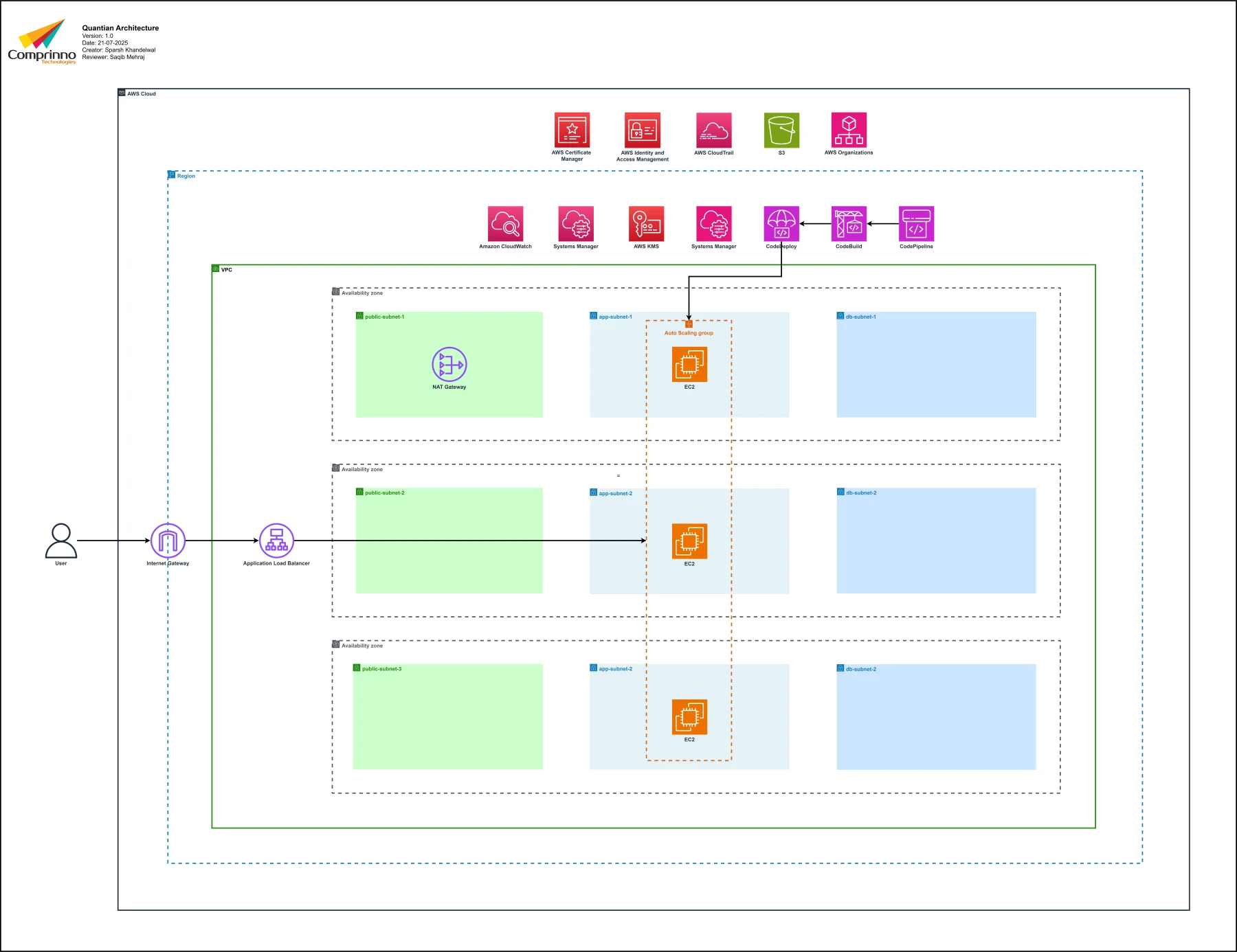
A comprehensive AWS infrastructure modernization initiative was implemented to enhance security, automate deployment workflows, and align the environment with AWS architectural best practices. As part of this initiative, the existing cloud landscape was also rationalized by consolidating selective workloads from external environments into AWS, enabling a more standardized and centrally governed architecture.
A CI/CD pipeline was implemented using AWS CodePipeline to automate application deployment. The pipeline was integrated with the organization’s GitHub repository, enabling automatic deployment whenever new code changes were pushed. This eliminated manual SSH-based deployments and ensured consistent, reliable application updates.
The network architecture was redesigned to improve security by implementing a VPC architecture with private subnets for application servers and databases. Public exposure was restricted to controlled entry points through an Application Load Balancer, significantly reducing the attack surface.
In parallel, a targeted migration effort was carried out to transition select workloads from external cloud platforms, including Google Cloud Platform and Azure, into AWS. This included the migration of a Windows-based workload from GCP, ensuring seamless integration with the AWS environment while maintaining performance, compatibility, and minimal disruption.
Amazon CloudFront was implemented as a Content Delivery Network (CDN) to improve content delivery performance and reduce latency for users. Amazon Route 53 was configured to manage DNS routing and ensure reliable domain resolution.
Security best practices were enforced through IAM-based access control, centralized logging with AWS CloudTrail, and operational monitoring using Amazon CloudWatch. Hardcoded secrets were identified, and recommendations were provided to migrate sensitive credentials to AWS Secrets Manager for secure storage and controlled access.
Existing Amazon S3 buckets were also migrated and reorganized to support application storage requirements while maintaining secure access controls.
Key Actions:
CI/CD Automation & Deployment Modernization:
-
A CI/CD pipeline was designed and implemented using AWS CodePipeline integrated with GitHub repositories. The pipeline enabled automated deployment workflows that triggered whenever developers pushed new code updates.
-
This automation eliminated manual SSH-based deployments and ensured consistent, repeatable release processes across environments. The new deployment model improved development velocity while significantly reducing operational overhead.
Secure Network Architecture Implementation:
-
The infrastructure architecture was redesigned following AWS security best practices. Application servers and database instances were migrated from public subnets to private subnets within the VPC.
-
External user traffic was routed through an Application Load Balancer deployed in public subnets, while backend services remained protected within private network layers. This significantly reduced direct internet exposure and strengthened the overall security posture.
Content Delivery & DNS Optimization:
-
Amazon CloudFront was implemented to accelerate content delivery and improve performance for globally distributed users. Static assets and application content were cached at edge locations, reducing latency and improving user experience.
-
Amazon Route 53 was configured for domain management and DNS routing, ensuring high availability and reliable domain resolution.
Security & Governance Improvements:
-
Security and governance best practices were implemented across the AWS environment. IAM policies and roles were configured to enforce controlled access to cloud resources.
-
Sensitive credentials previously hardcoded in application code were identified and recommendations were made to migrate these values to AWS Secrets Manager, enabling secure storage and controlled retrieval of secrets.
-
Operational visibility and auditing were strengthened using Amazon CloudWatch for monitoring and AWS CloudTrail for activity logging and governance.
Storage Migration & Resource Management:
- Existing Amazon S3 buckets were migrated and organized to support application storage requirements. Access controls and security configurations were reviewed to ensure compliance with AWS best practices.
Comprinno designed a secure and optimized AWS architecture to improve deployment efficiency, strengthen security, and align the customer’s cloud environment with AWS best practices. The existing manual deployment process was modernized by implementing an automated CI/CD pipeline using AWS CodePipeline integrated with GitHub, enabling seamless application updates whenever new code changes were pushed. The network architecture was restructured by migrating application servers and databases from public subnets to private subnets within the VPC, significantly reducing direct internet exposure. External user traffic was securely routed through an Application Load Balancer to ensure controlled and reliable access to backend services. Amazon CloudFront was implemented as a content delivery network to enhance performance and reduce latency for users, while Amazon Route 53 managed DNS routing for high availability and efficient traffic management. Security and governance were further strengthened through IAM-based access controls, centralized logging with AWS CloudTrail, and operational monitoring using Amazon CloudWatch. Additionally, hardcoded credentials within the application were identified, and AWS Secrets Manager was recommended to securely manage sensitive information, while Amazon S3 storage resources were migrated and optimized to support application data requirements.
04 · Results
Results
Benefits
-
Automated Application Deployments - The implementation of AWS CodePipeline eliminated manual deployment processes and enabled automated code releases directly from the GitHub repository. This significantly improved deployment speed, consistency, and operational efficiency.
-
Improved Security Architecture - Migrating application servers and databases to private subnets reduced internet exposure and aligned the infrastructure with AWS security best practices. Secure entry points through Application Load Balancers enhanced protection of backend services.
-
Enhanced Application Performance - The implementation of Amazon CloudFront improved application performance by delivering content through AWS edge locations, reducing latency and enhancing user experience.
-
Stronger Security & Credential Management - The transition toward AWS Secrets Manager improved credential security and enabled safer management of sensitive configuration values. IAM-based access control further strengthened governance across the environment.
-
Improved Monitoring & Governance - Operational visibility was enhanced through CloudWatch monitoring and CloudTrail logging, enabling better troubleshooting, performance tracking, and audit capabilities.
-
Reduced Multi-Cloud Complexity – Consolidating select workloads from GCP and Azure into AWS helped streamline operations, improve visibility, and enforce consistent security and governance controls across the infrastructure.
Conclusion
The AWS infrastructure modernization initiative successfully transformed Quantian’s cloud environment into a secure, automated, and scalable architecture aligned with AWS best practices. By automating deployments through AWS CodePipeline, improving network security through private subnet architecture, and implementing governance frameworks such as IAM, CloudWatch, and CloudTrail, the organization achieved improved operational efficiency and security.
The modernization effort significantly reduced manual operational overhead while enabling faster application delivery and improved system reliability. With a more secure and automated infrastructure foundation, Quantian is now well positioned to scale its platform, enhance operational agility, and support future growth with confidence. The inclusion of selective cross-cloud migrations further enabled infrastructure consolidation and improved operational consistency across the organization’s cloud landscape.