
01 · Client overview
Client overview
A cloud-native IT Service Management (ITSM) product company provides solutions that help enterprises manage incident tickets and service requests at scale. As part of its platform evolution, the company set out to integrate Generative AI capabilities to enable intelligent ticket summarization, similar ticket discovery, automated resolution guidance using historical incidents, and natural language based analytics. The objective was to improve decision-making, accelerate resolution times, and enhance technician productivity.
02 · Challenge
Challenge
The ITSM platform set out to evolve beyond manual ticket triage and basic automation toward a more intelligent, AI-driven operating model. This required building a scalable and secure system capable of supporting automated incident classification alongside a conversational AI chatbot. The solution needed to handle large volumes of historical and real-time ticket data while enabling natural language based ticket summarization, similar ticket discovery, and analytics. Key challenges also included integrating AI models with existing data systems such as object storage, search, and analytical data warehouses; maintaining conversational context across multi-turn chatbot interactions; ensuring response accuracy and relevance; and delivering actionable insights for both technicians and end users. In parallel, the platform needed strong monitoring, logging, and error-handling mechanisms that aligned with enterprise security and compliance standards.
03 · Solution
Solution
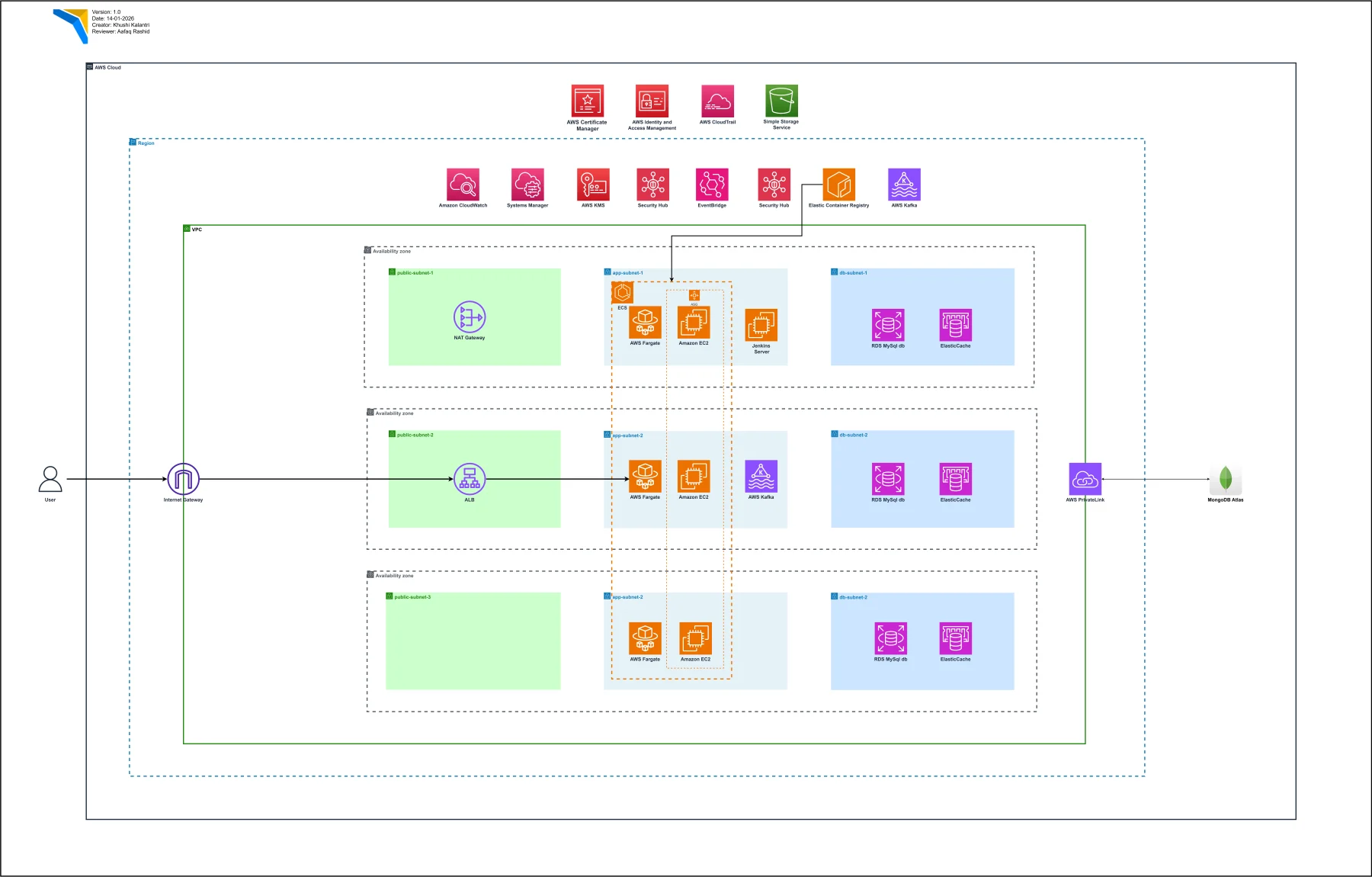
To enable intelligent ticket management, Comprinno implemented a Generative AI–powered ITSM chatbot that combines advanced reasoning with natural language interaction. The solution uses Amazon Bedrock Agent (Nova Pro) as the central intelligence layer to process, summarize, and analyze ticket data, delivering contextual insights and similar ticket discovery. A fully serverless architecture was built using AWS Lambda, Amazon S3, Amazon Redshift, AWS Glue, and an Application Load Balancer (ALB) to handle ticket ingestion, data processing, and real-time query flows between users and the AI model. The chatbot interacts with two knowledge bases: a structured Redshift-backed knowledge base for analytical queries and an unstructured S3-based vector store for historical ticket content. This design enables seamless reasoning across both structured and unstructured data. Lambda functions orchestrate data movement and AI workflows, executing ticket summarization, similarity searches, and analytics, while the ALB exposes low-latency, session-aware endpoints to support responsive, conversational interactions at scale.
Key Actions:
Bedrock Agent & LLM Integration :
-
Configured Amazon Bedrock Agent (Nova Pro) with domain-specific prompts for ticket summarization, similarity search, and analytics.
-
Managed multiple agent versions to support safe testing, rollback, and iterative improvements.
-
Applied structured prompt engineering to generate SQL queries, summaries, and context-aware responses from both structured and unstructured data.
Serverless Data Pipeline Architecture : -
Implemented automated ETL pipelines using AWS Lambda to ingest, clean, transform, and convert ticket data into S3 (vector store) and Redshift.
Knowledge Base Configuration :
-
Structured KB in Redshift for SQL-driven analytics and unstructured KB in S3 vector store for semantic search.
-
Integrated Lambda functions with KBs to retrieve data for summarization, analytics, and similarity queries.
-
Maintained data schema mapping, metadata sync, and indexing for optimized query performance.
Lambda Function Orchestration & Workflow Management :
-
Deployed multiple versioned Lambda functions (ChatbotHandler, TicketSummarizer, TicketAnalysis, QueryHandler) to manage request validation, session context, and AI reasoning.
-
Enabled asynchronous, stateless processing for scalability and horizontal load distribution.
-
Implemented logging, error handling, and retries with CloudWatch for observability and traceability.
Security & Governance Implementation :
-
Configured IAM roles, least privilege policies, and encrypted data at rest/in transit with AWS KMS
-
Isolated workloads in private VPC subnets with NAT gateways for secure access and restricted database exposure.
-
Applied Bedrock guardrails, access controls, and logging for safe AI outputs and compliance.
Performance Monitoring, Scalability & Optimization :
-
Set up CloudWatch dashboards for latency, invocation counts, error rates, and model output accuracy.
-
Designed serverless architecture with ALB + Lambda + Bedrock for automatic horizontal scaling based on user load.
-
Optimized Lambda execution, vector searches, and Redshift queries to minimize response time and improve throughput.
Comprinno designed a secure, scalable, and highly available serverless architecture on AWS to support customer requirements for data processing and analytics. The solution leverages Amazon API Gateway as the entry point to handle user requests, which securely invoke AWS Lambda functions deployed across multiple Availability Zones, ensuring high availability, fault tolerance, and automatic scaling.
The Lambda functions interact with Amazon DynamoDB as the primary data store, enabling fast and reliable NoSQL data access for real-time queries and updates. All components are deployed within a Virtual Private Cloud (VPC), with public subnets hosting NAT Gateways to allow secure outbound connectivity for private application subnets.
Security and governance are enforced using AWS IAM for access control, AWS KMS for encryption, Amazon Cognito for identity and authentication, and AWS WAF to protect APIs from common web threats. Continuous security monitoring and compliance visibility are provided through AWS GuardDuty, AWS Security Hub, and AWS CloudTrail.
Operational monitoring and observability are achieved through Amazon CloudWatch for logs and metrics, Amazon OpenSearch for log analytics, and AWS Systems Manager for centralized operational management. Amazon S3 is used for object storage, log archival, and backups, while AWS Glue and Amazon SageMaker support data processing and advanced analytics use cases. This architecture ensures robust security, seamless scalability, and minimal operational overhead, aligning well with cloud-native and data-driven application objectives.
04 · Results
Results
Benefits
-
Intelligent Ticket Management: The GenAI-powered ITSM chatbot delivers automated ticket summarization, similarity detection, and analytics, reducing manual triage effort and accelerating incident resolution.
-
Operational Efficiency & Cost Reduction: Minimizes repetitive manual work for IT support teams, allowing technicians to focus on complex issues, improving productivity, and lowering operational costs.
-
Data-Driven Decision Making: Provides real-time insights and analytics via Redshift and Bedrock-powered reasoning, enabling informed decisions and faster prioritization of incidents.
Enhanced User Experience: Context-aware, conversational interactions improve visibility into ticket history and related incidents, supporting multi-turn queries and more intuitive engagement for users.
Conclusion
The implementation of the Generative AI–powered ITSM chatbot transformed incident management by combining AI-driven intelligence with AWS-native services. Built using Amazon Bedrock, AWS Lambda, Amazon Redshift, and S3-based vector stores, the solution delivers real-time, context-aware ticket summarization, similarity search, and advanced analytics. This approach effectively eliminates manual ticket triage, reduces delays in insight generation, and ensures consistent incident handling while maintaining high accuracy and operational efficiency. Beyond ITSM, the architecture establishes a scalable, secure, and modular AI foundation that can be extended to other enterprise use cases such as automated customer support, knowledge management, and predictive analytics. The result is a robust, cost-efficient, and intelligent platform that enhances user experience, boosts technician productivity, and enables sustained operational excellence.